Awadhi Qorma vs Delhi Korma: Understanding the Distinct Flavours of Lucknow and Purani Dilli
By SwaadSathi · · Updated 08 Oct 2026
Though both trace their lineage to Mughal court kitchens, Awadhi Qorma and Delhi Korma follow completely different culinary philosophies. Here is how spice balances, onion textures, and gravy bases set them apart.
A Tale of Two Imperial Kitchens
Few dishes command as much reverence in North Indian culinary history as the korma (or qorma). Rooted in the Persian technique of braising meat in yogurt, stock, and spices, this dish evolved dramatically depending on the patronage it received. While Delhi's korma matured within the bustling, spice-heavy banquets of the Mughal capital, Lucknow's Awadhi qorma was refined in the royal courts of the Nawabs, where delicacy, perfume, and velvety textures reigned supreme.
To the casual diner, both dishes appear as rich meat curries cooked with fried onions, yogurt, and whole spices. However, an understanding of their construction reveals stark contrasts in technique, visual appearance, texture, and aroma. In Lucknow, cooking is an exercise in restraint and layered extraction, whereas Old Delhi approaches the dish with assertive heat, rich color, and a signature grainy body.
The Browned Onion: Danedaar Grain vs Silken Emulsion
The treatment of fried onions (barista or biryan) represents the single most important technical difference between the two styles. In both preparations, sliced onions are fried in ghee until moisture evaporates and sugars caramelize, but how they are processed afterward dictates the final mouthfeel of the gravy.
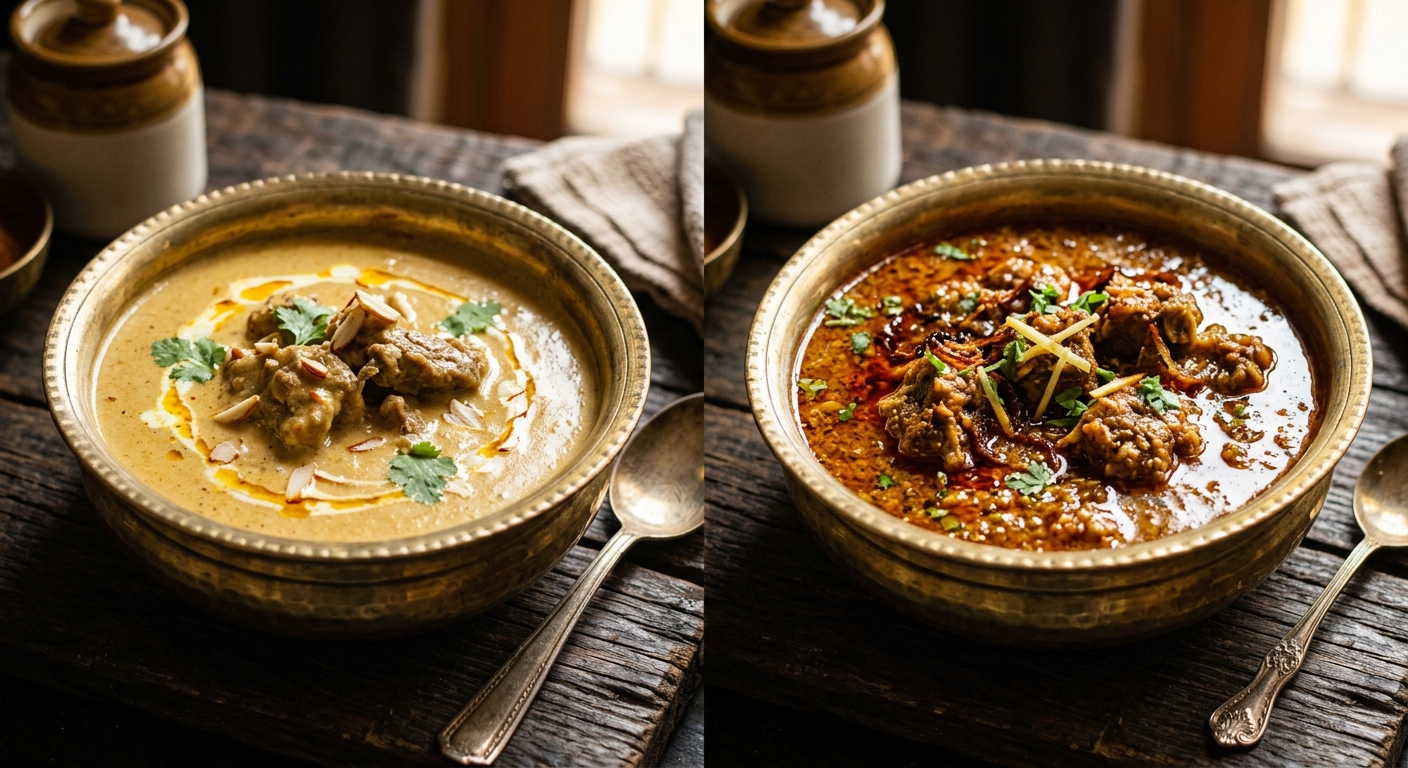
In Purani Dilli (Old Delhi), the onions are browned to a deep, dark mahogany. Once cooled and crisp, they are coarsely crushed by hand or gently pulsed without turning into water. When introduced to the braising meat alongside hung curd, these crushed onions suspend in the rendered fat, creating what ustad-e-bawarchi (master cooks) call a 'danedaar' gravy—a distinct, coarse, bead-like texture that clings heavily to the mutton or chicken.
Awadh treats the onion with an entirely different temperament. In a traditional Lakhnawi bawarchikhana, the onions are fried to an even, pale golden hue, strictly avoiding bitterness or heavy browning. They are then ground into an ultra-fine paste with a stone sil-batta, often combined with blanched almonds, melon seeds (magaz), or a splash of milk. This paste melts seamlessly into the braise, producing a silky, emulsion-style gravy with no visible granules.
The Spice Architecture: Fragrant Florals vs Earthy Robustness
The spice profile of Delhi korma is built for vibrancy and immediate impact. Whole spices like black cardamom, cloves, cinnamon, and whole black peppercorns are cracked directly into smoking ghee to infuse the cooking medium. Delhi korma embraces ground coriander powder in generous amounts—an ingredient that adds earthy volume and helps anchor the deep red chilli powder. The result is a savory, robust profile with an upfront heat and a deep, savory foundation.
Awadhi qorma, by contrast, shuns excessive coriander or sharp chili heat. The Lucknow profile is dominated by fragrant warm spices: green cardamom, jaiphal (nutmeg), and javitri (mace). Nawabi cooks traditionally rely on a subtle spice pouch or finely sifted 'potli masala' that includes rare aromatics such as rose petals, star anise, vetiver (khas), and stone flower (pathar ke phool). The heat is muted, allowing the natural sweetness of the meat and the aroma of ghee to surface without burning the palate.
The Gravy: Color, Fat, and Finishing Touches
Look at a serving of Delhi korma from the lanes of Jama Masjid, and the first detail to catch the eye is the floating layer of bright crimson roghan (scented spiced fat). Delhi cooks rely on vibrant degi mirch or Kashmiri red pepper combined with the deep tones of caramelized onions, yielding an amber to brick-red sauce that breaks distinctly from the rendered ghee.
Awadhi qorma offers a much softer visual palette, leaning toward a golden-fawn, pale copper, or light cream-tinted brown. The gravies are often enriched toward the final stages of slow cooking (dum) with clotted cream (malai) or reduced milk, giving them a glossy sheen rather than a sharp separation of oil. Cooking meat on the bone over low heat allows the marrow and gelatin to dissolve gradually, creating natural body without needing excessive starch or thickeners.
Finally, the finish signals the regional lineage unmistakably. Delhi korma is finished with a modest splash of kewra water and sliced ginger juliennes to cut through the heavy ghee. An Awadhi qorma, however, is sealed with royal perfumery: a careful balance of high-grade saffron steeped in warm milk, concentrated kewra water, and occasionally a microscopic drop of meetha ittar (edible perfumed oil), imparting an aroma that blooms the moment the handi is opened.
Appreciating the Distinction
Neither style can be termed superior; they represent two distinct artistic peaks of Indian gastronomy. Delhi korma provides the soul-stirring, hearty pungency suitable for thick tandoori rotis and crisp khamiri naans. Awadhi qorma offers the quiet, perfumed finesse crafted to accompany paper-thin roomali rotis or delicate sheermals. Recognizing the way onions are crushed, spices are layered, and fat is rendered transforms a simple plate of braised meat into a masterclass in regional heritage.