Cooking Phirni in Earthen Pots: How Rice Grain Texture and Terracotta Alter Awadhi Desserts
By SwaadSathi · · Updated 08 Oct 2026
Explore the culinary mechanics of traditional Awadhi phirni, focusing on the critical grind of rice and the transformative role of porous terracotta pots.
The Distinct Identity of Awadhi Phirni
In the culinary landscape of Lucknow, milk-based desserts hold a revered place on the traditional dastarkhwan. While kheer relies on whole grains of rice simmered slowly until soft, phirni is defined by a completely different physical structure. Originating in royal court kitchens and popularized across the streets of Chowk and Aminabad, authentic phirni depends on two foundational elements: the precise mechanical breakdown of the rice grain and the thermal, porous properties of unglazed earthenware known locally as shikora or sakora.
Understanding how these two factors interact provides insight into why phirni achieves a velvety, spoonable firmness without relying on artificial thickeners, starches, or heavy gelatinization. It is an exercise in practical food science refined over generations of regional culinary practice.
The Mechanics of Rice Grain Texture: The Dardara Grind
The texture of phirni is entirely determined before the cooking vessel meets the flame. Using whole rice yields kheer, while processing rice into a fine flour produces a gluey, paste-like porridge reminiscent of baby food. The ideal texture for Lucknow-style phirni is described in Hindi and Urdu as dardara—a coarse, granular meal resembling fine semolina or polenta.
Achieving this requires a specific pre-treatment of the grain. Traditionally, aged aromatic rice such as Basmati or small-grained fragrant varieties are washed thoroughly to remove excess surface starches, drained, and spread out on a clean cotton cloth to air-dry completely in the shade. Drying the rice ensures that when it is pounded or pulsed, the grains fracture cleanly along crystalline cell boundaries rather than crushing into a moist, clumped powder.
When this granular rice is introduced to warm, simmering milk, the fractured starch granules (composed of amylose and amylopectin) hydrate at a controlled rate. Because the pieces are small, heat penetrates them evenly, releasing starch into the surrounding dairy matrix without dissolving the grain entirely. As the starch swells and leaches out, it binds the water phase of the milk. The remaining particle cores stay distinct, imparting a delicate, microscopic toothsome bite that prevents the dessert from feeling cloying or heavy on the palate.
The Thermal and Porous Role of Terracotta
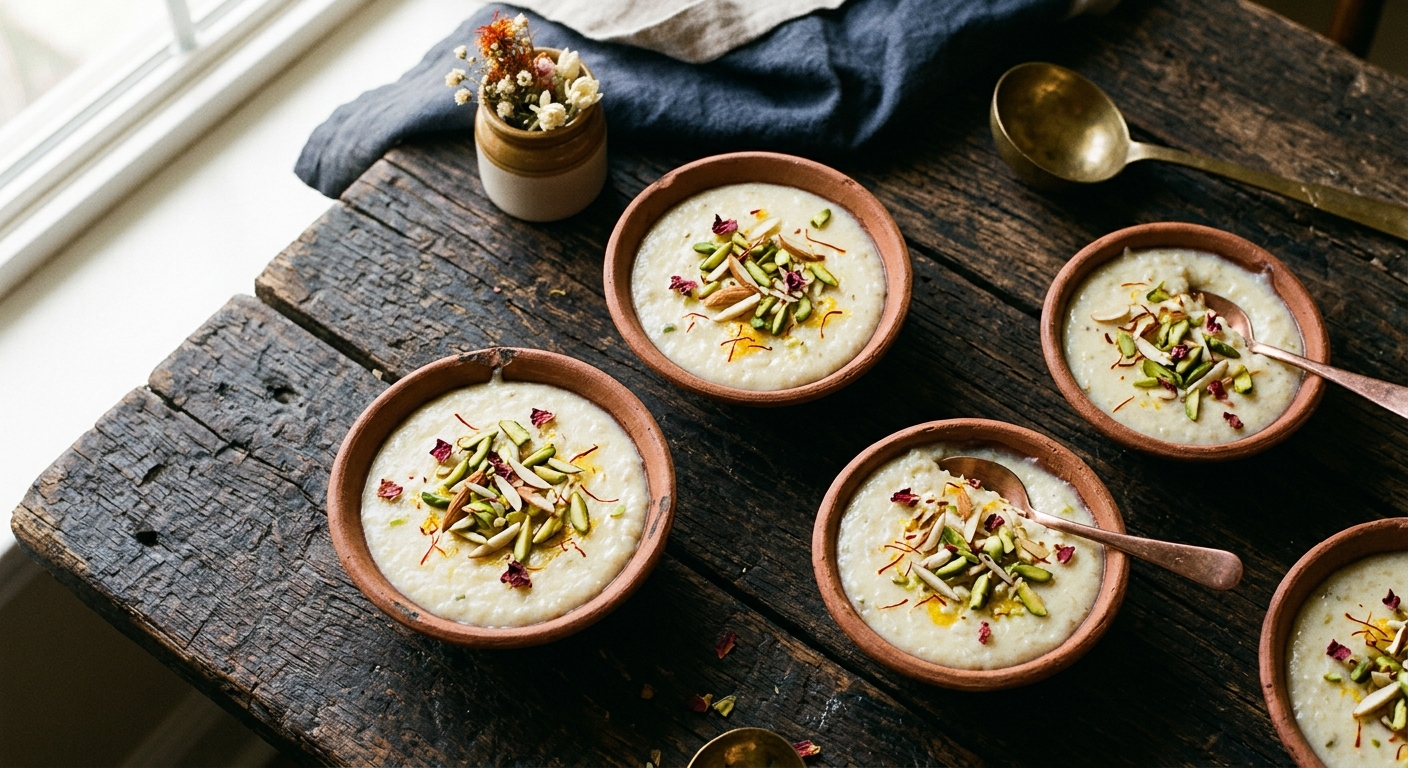
Cooking phirni is only half the process; setting it completes the transformation. Unlike modern puddings poured into glass ramekins or metal bowls, authentic phirni must be poured warm directly into unglazed, raw terracotta bowls.
Terracotta is fundamentally porous clay fired at relatively low temperatures. This porosity plays an active role in modifying the dessert through capillary action:
Moisture Absorption and Concentration: As warm phirni settles into an unglazed sakora, the dry micropores of the clay immediately begin drawing out excess free moisture from the pudding. This passive dehydration concentrates the milk fats, dairy solids, and cooked starches near the edges and bottom of the dish. Consequently, the phirni sets into a firm, custard-like consistency that holds its shape cleanly on a spoon, which cannot be duplicated in non-porous glass or ceramic containers.
Evaporative Cooling: Lucknow summers demand desserts that soothe the system. As the porous earthenware absorbs moisture, evaporation occurs continuously along the exterior walls of the vessel. This process naturally cools the dessert down, creating a refreshingly chilled serving temperature even before the bowls are transferred to modern refrigeration.
Aromatic Impartation: The unglazed clay introduces an aroma known across northern India as sondhi khushbu—the scent of rain hitting parched soil, biologically associated with geosmin and mineral compounds. When warm milk contacts the raw earth, these volatile aromatic compounds blend with milk fat, saffron, and crushed green cardamom, creating an earthy counterweight to the sweetness of the sugar.
Preparing Authentic Phirni at Home
To replicate the authentic Awadhi texture and setting technique in a home kitchen, focus strictly on proper proportions and vessel preparation.
Begin by choosing long-grain aged Basmati rice. Wash roughly 50 grams of rice per liter of full-fat buffalo or whole cow's milk. Dry the grains thoroughly on a tea towel for at least two hours before grinding them in short pulses. The texture should feel distinctly gritty between your fingertips.
Soak new, unglazed terracotta bowls in clean water for an hour to clear loose clay dust, then allow them to air-dry completely before use. Pouring phirni into bone-dry bowls maximizes capillary absorption, whereas pouring into wet bowls reduces moisture pull and risks a watery set.
Simmer full-fat milk slowly in a heavy-bottomed vessel until reduced by roughly one-quarter. Gradually whisk in the ground rice, maintaining a gentle simmer and stirring constantly to prevent the heavy grains from sinking and scorching at the base. Once the mixture thickens to a light ribbon consistency, add sugar and aromatic elements like cardamom powder and saffron infused in warm milk. Do not overcook on the stove; the pudding will continue to firm up significantly as it cools inside the clay vessel.
Preserving a Subtly Engineered Tradition
In contemporary confectionery, stabilizers and thickeners often replace deliberate culinary technique. The classic Awadhi phirni remains a study in minimal, balanced engineering: raw clay manipulating hydration, and coarsely milled grain controlling viscosity. Respecting the grain's size and utilizing unglazed earthenware ensures this historic dessert retains its traditional mouthfeel, cooling quality, and nuanced flavor profile.