Kakori Kebab Essentials: The Role of Mace, Rose Water, and Raw Papaya
By SwaadSathi · · Updated 08 Oct 2026
Explore the culinary mechanics behind Awadh’s most delicate skewered delicacy, where raw papaya tenderizes meat to silk and mace meets rose water for balanced fragrance.
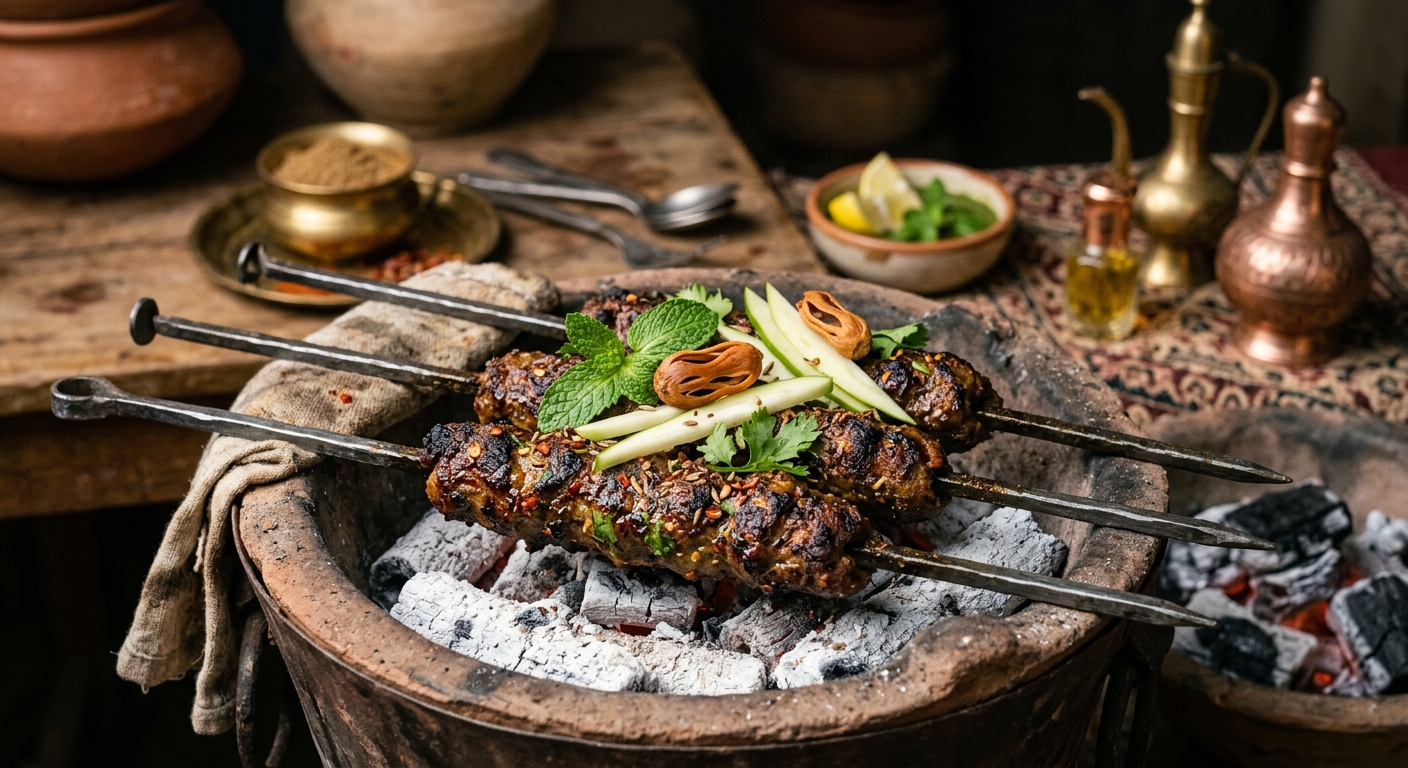
The Anatomy of an Awadhi Masterpiece
Among the celebrated kebabs of the Awadh region, the Kakori kebab occupies a distinct place. Originating in Kakori, a historical town situated on the outskirts of Lucknow, this kebab was perfected by royal khansamas seeking an impossibly soft, silken texture that required no chewing. While commonly compared to the pan-seared Galouti kebab, the Kakori is unique because it achieves this delicate, melt-in-mouth consistency while being grilled over an open charcoal brazier (sigdi) on thin skewers.
Holding minced meat onto a skewer without it disintegrating into the embers demands precise culinary chemistry. The signature texture and aroma of a true Kakori kebab rely on three foundational components: raw papaya for cellular breakdown, mace for an elegant, warm aroma, and rose water to temper rich animal fat with regal sweetness.
Raw Papaya: The Enzymatic Tenderizer
The hallmark of a Kakori kebab is its pâte-like tenderness. Standard mincing alone cannot produce this structural surrender; it requires biochemical intervention through kaccha papita, or raw green papaya.
Raw papaya contains papain, a naturally occurring proteolytic enzyme. When applied to finely minced meat—traditionally mature goat meat or lamb taken from the leg (raan)—papain breaks down tough collagen and peptide bonds within muscle fibers. This process differs markedly from mechanical tenderizing or acid marinades (like yogurt or lemon juice), which can cause the meat to turn rubbery if overexposed.
For the process to succeed, the proportion and resting time must be calibrated carefully. Approximately 30 to 40 grams of fresh raw papaya paste per kilogram of meat is the conventional standard. The paste must include the green peel, as the highest concentration of papain sits immediately beneath the outer skin. Allowed to rest between four to six hours in a cool environment, the enzymes relax the meat proteins thoroughly, creating a fine emulsion when combined with rendered kidney fat (charbi) and roasted gram flour (bhuna besan).
Mace (Javitri): Subtle Warmth and Delicate Spicing
While tenderization governs texture, the Awadhi spice profile relies on nuance rather than searing heat. In Kakori kebabs, the aromatic backbone is mace, locally known as javitri.
Mace is the lacy, reddish-orange aril that surrounds the nutmeg seed. While it shares some chemical constituents with nutmeg, such as myristicin and elemicin, mace is distinctly milder, more floral, and possesses a delicate citrus-like undertone. Heavy, pungent spices like black pepper or excessive cloves can overwhelm delicate lamb, whereas finely powdered mace integrates evenly throughout the emulsion.
In traditional Lucknowi potli masala formulations, toasted mace is paired with green cardamom, allspice (kabab chini), and dried rose petals. It provides a warm, lingering finish on the palate that cuts through the high fat content without scorching the tastebuds. Because Kakori kebabs cook quickly over glowing coals, the heat flash-releases the essential oils in the mace, perfuming the exterior while preserving the moisture within.
Rose Water: The Olfactory Balancing Act
Awadhi cuisine has long treated scent as an integral component of digestion and enjoyment. In the Kakori kebab, distilled rose water (gulab jal) or pure rose essence (ruh gulab) serves as an olfactory bridge.
The mixture for Kakori kebabs utilizes a substantial proportion of rendered fat—often up to 20 to 25 percent—to ensure the paste remains juicy as it cooks over dry coals. Fat absorbs and holds volatile flavor compounds, but it can also leave a heavy, greasy mouthfeel if not counterbalanced. The addition of rose water brings an astringent, cooling floral top-note that balances the richness of the fat and the earthiness of fried onion paste (barista).
Experienced cooks incorporate food-grade rose water at the very final stage of kneading the mince. When the kebab hits the high radiant heat of the charcoal, the water vaporizes gently, carrying subtle floral notes into the smoky crust and leaving a clean, fragrant aftertaste.
The Critical Role of Technique: Mincing and Skewering
Ingredients alone do not guarantee a successful Kakori kebab; mechanical technique determines whether the meat holds the skewer:
- Multiple Passes: The meat and fat must pass through a fine mincer plate at least three to four times, followed by traditional working on a sil-batta (grinding stone) to achieve a homogeneous paste.
- Temperature Control: The meat mixture must be kept chilled during handling. If the animal fat warms and melts prematurely, the emulsion breaks, causing the kebab to slip off the seekh during roasting.
- Gentle Roasting: Once molded onto flat or square skewers using moistened hands, the kebabs are cooked over gentle, white-ashed coals, turned frequently, and basted with melted ghee until a thin, golden crust forms around the velvet core.
Preserving an Authentic Legacy
Understanding the interplay between raw papaya, mace, and rose water illuminates why the Kakori kebab has endured as an icon of Awadhi dining. It is not merely an exercise in indulgence, but a sophisticated synthesis of enzymatic tenderization, restrained spicing, and aromatic balancing that honors the refined culinary heritage of Lucknow.