Sheermal vs Taftan: Understanding Lucknow’s Iconic Saffron Flatbreads
By SwaadSathi · · Updated 08 Oct 2026
While both Sheermal and Taftan are golden, saffron-scented breads deeply rooted in Awadhi dining, their dough, leavening, and textures set them apart.
The Royal Bread Culture of Awadh
In the culinary landscape of Lucknow, bread is not merely an accompaniment to meat gravies; it is an art form refined over centuries in the royal kitchens of the Nawabs. Awadhi cuisine is renowned for its delicate balance of aromas, slow-cooking techniques, and sophisticated breads baked in specialized clay ovens. Among the pantheon of festive flatbreads, Sheermal and Taftan stand out for their golden hues and saffron-perfumed aromas. While casual diners often confuse the two due to their shared warm tint and royal pedigree, distinct culinary traditions govern their preparation, ingredients, and texture.
What Is Sheermal?
The name Sheermal derives from the Persian words 'sheer' (milk) and 'malidan' (to rub or knead). True to its etymology, Sheermal is a flatbread kneaded exclusively with warm milk rather than water. Originating in Persian and Central Asian baking cultures, it was embraced by the royal dastarkhwans of Northern India and adapted thoroughly into the identity of Lucknow's old quarters, particularly the bakeries around Chowk.
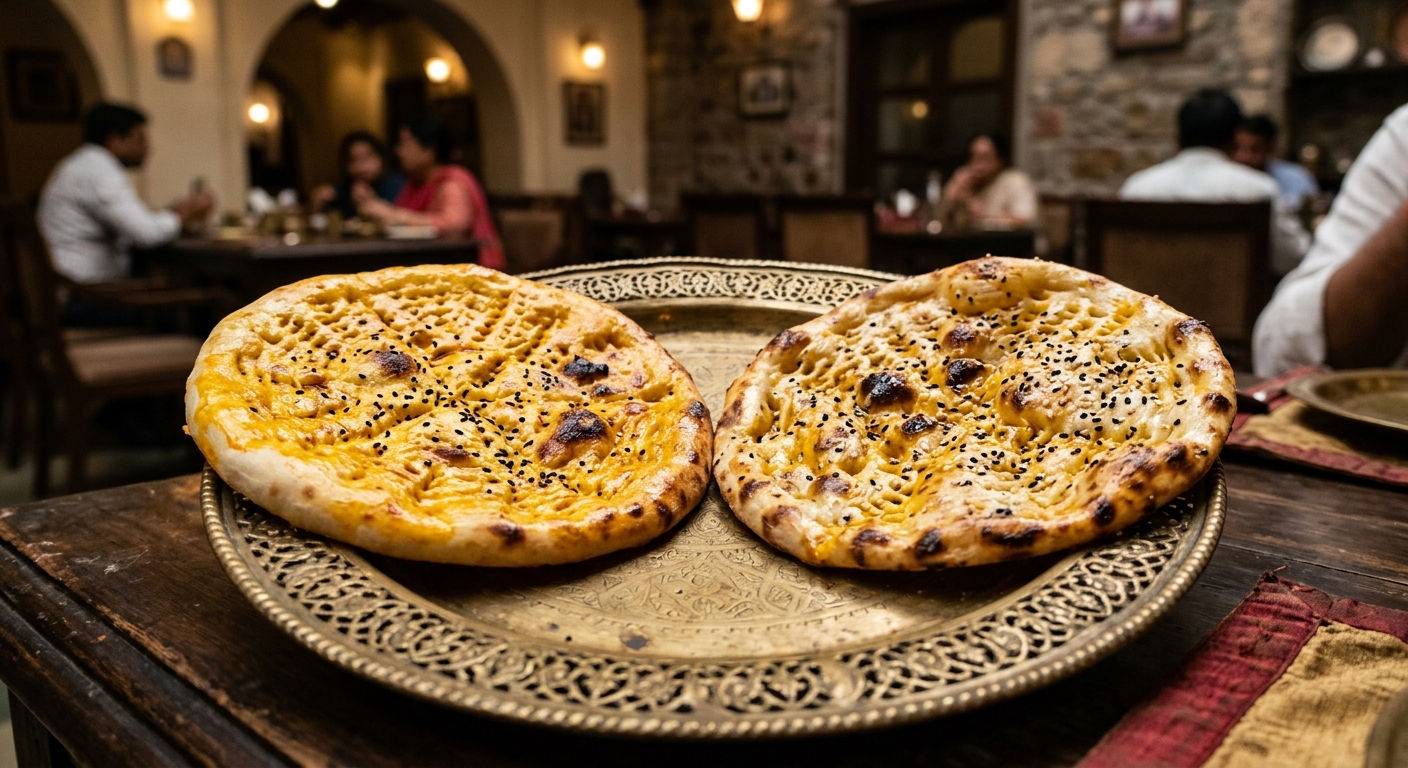
To make Sheermal, refined wheat flour (maida) is mixed with pure ghee, sugar, and milk. The dough is continuously worked to develop a pliable, enriched structure. The defining characteristic of Sheermal is its saffron wash: warm milk steeped with saffron strands (zafran) and kewra water is brushed liberally over the rolled rounds before baking. Traditionally pricked with a rolling pin adorned with blunt nails or patterned wooden stamps, the bread is baked inside an open-flame tandoor until the surface blisters into an amber-orange mosaic. The resulting crumb is dense yet tender, with a distinct, lingering sweetness.
What Is Taftan?
Taftan, also originating from Persian culinary roots, translates historically to heating or baking on a griddle or oven. While Sheermal leans into milk and sweetness, Taftan represents an enriched leavened bread that emphasizes a softer, airier bite. Historically found across Iran, Pakistan, and the royal centers of Uttar Pradesh, Taftan entered Lucknow's kitchens as a sophisticated bread reserved for feasts.
The dough for Taftan typically incorporates flour, milk or yogurt, ghee, and a mild leavening agent. Some historic recipes also introduce ground cardamom, rose water, or a hint of saffron into the crumb itself. Unlike the dense, biscuit-like crumb of Sheermal, Taftan has a pillowy structure closer to a rich brioche or a light naan. It is traditionally garnished with poppy seeds, nigella seeds, or slivered nuts, and often finished with a light wash of saffron milk or egg glaze to produce a glossy, golden top layer.
Flour, Liquids, and Leavening: The Key Differences
The primary technical difference between Sheermal and Taftan lies in the hydration and leavening process. Sheermal relies on milk as the sole hydrator. Because it does not use aggressive leaveners, the dough remains compact and rich. The high proportion of ghee and sugar gives Sheermal its characteristic crisp-on-the-outside, short-on-the-inside mouthfeel.
Taftan, by contrast, uses leavening to produce gas bubbles that create an open, fluffy crumb. The addition of yogurt or curd in many traditional recipes softens the gluten and adds a mild, almost imperceptible tang that balances the rich dairy fats. Where Sheermal feels flat and dense, Taftan presents an airy rise with defined pockets of air throughout the cross-section.
Flavor Profiles: Sweetness and Spices
Flavor is another area where the two breads diverge significantly. Sheermal is unmistakably sweet. The sugar is folded directly into the dough liquid, making it sweet enough to occasionally be eaten as a standalone snack alongside hot tea. The predominant aromatics are saffron and kewra (screwpine water), which impart a warm, floral perfume that permeates every bite.
Taftan features a much more nuanced, savory-leaning sweetness. While it contains sugar, the sweetness is subtle, meant to complement rather than dominate. Taftan frequently highlights cardamom powder and sometimes fennel or mace, delivering a spiced warmth rather than pure floral sweetness. The presence of seeds like nigella (kalonji) or sesame on the crust adds an earthy, nutty dimension absent in standard Sheermal.
Texture and Mouthfeel
When you break a piece of warm Sheermal, it yields with a gentle snap on the crust, revealing a crumb that feels rich, buttery, and slightly crumbly. Because of its density, it absorbs rich gravies slowly without dissolving into mush. It retains structural integrity even when dipped into heavy, fat-rich gravies.
Taftan breaks apart like a soft yeast roll or enriched milk bread. Its crust is supple and pliant, often with a slight sheen from ghee or saffron milk. When torn, it stretches softly. In the mouth, it dissolves quickly, offering a buttery, cloud-like texture that pairs well with smooth, velvety preparations.
Culinary Pairings on the Awadhi Dastarkhwan
In Lucknow's classical food service, flatbread selection is dictated by the pairing curry. Sheermal is famously the non-negotiable partner for Awadhi Galawat ke Kabab. The softness of the smoked, finely minced kebab matches the rich, slightly sweet bite of the bread, creating an interplay of savory spice and sweet saffron. Sheermal is also traditionally paired with slow-cooked Nihari, where the robust heat of the bone-marrow broth contrasts with the mellow, milky flatbread.
Taftan, with its airy texture and milder sweetness, is traditionally matched with thick, fragrant gravies like Murgh Awadhi Korma, Gosht Pasanda, or rich vegetarian curries such as Paneer Kundan Kalia. Because it is lighter, Taftan does not overwhelm the delicate nut-and-onion pastes of Nawabi kormas, allowing the gravy's complex spices to take center stage.
Preserving Lucknow's Baking Traditions
Both Sheermal and Taftan showcase the depth of Lucknow’s classical baking repertoire. Rather than using bread simply as a neutral vehicle for curry, the bakers of Awadh engineered these flatbreads to enhance the dining experience through deliberate choices in fat, hydration, and aromatics. Understanding the contrast between the sweet, dense crunch of Sheermal and the pillowy, lightly spiced lift of Taftan allows food lovers to fully appreciate the layered history of Lucknow's royal tables.