The Science of Potli Masala: Essential Whole Spices That Define Authentic Lucknowi Mutton Yakhni
By SwaadSathi · · Updated 08 Oct 2026
Discover the culinary science behind the traditional potli masala, exploring how whole spices infuse clarity, aroma, and balance into authentic Lucknowi mutton yakhni.
The Function of the Muslin Bundle in Awadhi Cooking
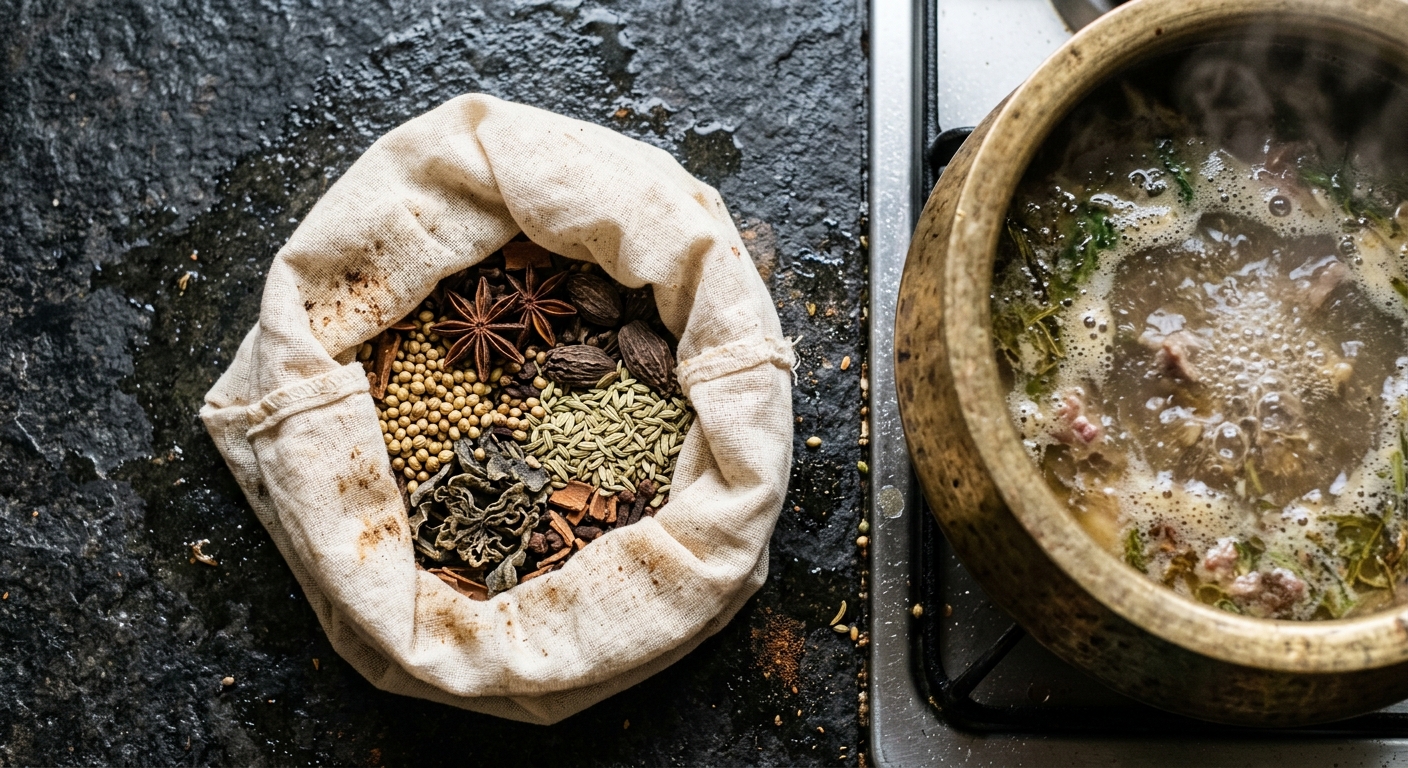
In the classical culinary traditions of Lucknow, clarity and subtlety govern every layer of flavor. Mutton yakhni—a fortified bone and meat broth that forms the aromatic foundation for Awadhi biryani and delicate shorbas—relies heavily on a technique known as the potli. A potli is a loose bundle of natural, unbleached muslin cloth that encases a designated selection of whole spices, aromatics, and roots. Rather than tossing spices directly into the pot, Awadhi khansamas suspend or submerge this parcel into the simmering liquid.
From a culinary science perspective, the potli serves two essential purposes: controlled extraction and particulate filtration. Whole spices contain fibrous cell walls, insoluble starches, and heavy tannins. If left loose in the broth over prolonged simmering, these components break down into minute particles that cloud the stock and introduce unwanted bitterness. The fine weave of the cotton allows water and rendered animal fats to flow freely across the botanical tissue while trapping woody fragments, resulting in a pristine, translucent yakhni with refined depth.
The Core Botanical Foundations: Fennel and Coriander
At the center of any authentic Lucknowi potli masala sits a foundational ratio of whole coriander seeds (sabut dhania) and sweet fennel seeds (saunf). Unlike standard north Indian gravies that prioritize pungent pungency, Lucknowi yakhni builds upon an aromatic, cooling, and herbaceous baseline.
Coriander seeds are rich in linalool, a terpene that imparts a gentle floral and citrus aroma. When gently simmered in an aqueous medium, coriander provides a structural backbone without sharp acidity. Fennel seeds contribute anethole, a sweet, licorice-like compound that cuts through the rich, mineral-heavy profile of mutton bones and connective tissue. Together, coriander and fennel make up the bulk of the potli volume, buffering the stronger spices and ensuring the base stock tastes light on the palate.
The Warm Resins: Cardamom, Cloves, and Cinnamon
Once the base is established, warm aromatic spices are introduced in deliberate, measured proportions. Green cardamom (chhoti elaichi), black cardamom (badi elaichi), cloves (laung), and true Ceylon cinnamon (dalchini) provide the classic warm spice profile characteristic of northern Indian royal kitchens.
Green cardamom yields cineole and terpinyl acetate, providing sharp, high-frequency herbal freshness. Black cardamom, dried over open fires, brings humulene and caryophyllene, delivering an earthy, wood-smoke note that matches the depth of collagen-rich mutton cuts such as shank (nalli) and shoulder (dast). Cloves contribute concentrated eugenol, an intense aromatic that acts as an antibacterial preservative and provides warmth. Because eugenol can easily dominate a broth, only a modest count of cloves is used to avoid overwhelming the delicate stock.
The Distinctive Awadhi Signatures: Stone Flower and Roots
What differentiates a generic north Indian mutton broth from an authentic Lucknowi yakhni is the inclusion of specialized botanical materials. Foremost among these is pathar ke phool (stone flower or Parmotrema perlatum), an edible lichen. When subjected to moist heat, stone flower releases a distinct, earthy, moss-like aroma that creates the unmistakable olfactory signature of Awadhi cuisine.
Traditional recipes also feature pan ki jad (greater galangal or betel root) and pipli (long pepper). Pan ki jad imparts a pine-like, slightly peppery warmth that supports mutton digestion, while pipli introduces piperine with a slower, more diffuse heat profile than standard black peppercorns. Dried rose petals (gulab patti) are frequently tucked into the bundle as well, offering gentle floral notes that round out the heavy resinous compounds released by the barks and seeds.
Solubility: How Broth Chemistry Extracts Flavor
The culinary science of yakhni extraction relies on the distinct solubility behaviors of essential oils. Spices carry both water-soluble compounds and fat-soluble (lipophilic) compounds. When mutton pieces, marrow bones, water, and the potli simmer together over gentle heat (dheemi aanch), two concurrent extractions occur.
Water extracts the lighter, volatile hydrophilic molecules—such as the organic acids and mild esters in fennel and coriander. Simultaneously, the rendered tallow and melted marrow from the mutton act as lipid solvents, drawing out lipophilic aromatics like eugenol, anethole, and caryophyllene that do not dissolve efficiently in plain water. By cooking at a sub-boiling simmer, emulsion is minimized, preventing the broth from becoming greasy and murky while ensuring complex aromatics bind directly to the floating fat droplets and dissolved gelatin.
Assembling and Managing the Potli for Optimal Results
The physical preparation of the potli directly influences extraction efficiency. The spices must be enclosed loosely within the muslin square, leaving sufficient internal headspace. When dry seeds absorb moisture, they expand significantly. If tied too tightly, water cannot circulate through the interior of the bundle, resulting in uneven and incomplete extraction of essential oils.
A well-prepared mutton yakhni typically simmers with its potli for forty-five to seventy-five minutes, depending on the cut of meat and whether a pressure vessel or open vessel is utilized. Once the meat reaches fork tenderness and the bones have surrendered their soluble proteins, the potli is gently pressed against the side of the pot to release any trapped liquor before being discarded. The outcome is an aromatic, amber-tinted yakhni carrying the soul of Awadhi gastronomy: intricate, balanced, and remarkably clean.